
A Brief History of Food: Faking it


Today “mock meat” is widely accepted and eaten as a healthier alternative to animal meat. Such substitutes use innovative formulations of plant-derived ingredients to mimic the taste, texture, and appearance of meat. While the resulting recipes may vary considerably, the core ingredients typically include protein sources like soy, peas, or mushrooms, alongside binders, fats, flavourings, and colourings, to produce sustainable alternatives to traditional meat products. Likewise, many people use alternatives when allergic to common, mainstream foods such as dairy products or nuts to name but two. Many products made out of soy, almond or coconut substitute for milk. Vegans also substitute foods, such as vegan bacon or vegan cheese, which are made from ingredients that simulate but do not contain meat or dairy products.
Clearly the science and technology to create mock meat is relatively new phenomenon but imitating foods is not without historical precedence. Both Roman and Mediæval chefs saw great skill in presenting diners with what looked like one thing but was in fact something completely different. Disguising a dish’s true nature or creating fantastical beasts was both a way of entertaining guests at a feast and also a display of the host’s wealth and prestige. One Roman example is included in volume two of Petronius Arbiter’s Satyricon which focuses on a dinner at the estate of Trimalchio, a freedman of enormous wealth who entertains his guests with ostentatious and grotesque extravagance. A succession of courses are presented, some of them disguised as other kinds of food or arranged to resemble certain zodiac signs. One notable instance involves a pig that Trimalchio pretends to berate his cook for not gutting it before roasting:

“[Trimalchio] said, “Since your memory's so short, you can gut him right here before our eyes!” The cook put on his tunic, snatched up a carving knife, with a trembling hand, and slashed the hog’s belly in several places. Sausages and meat puddings, widening the apertures, by their own weight, immediately tumbled out.” (Petronius Arbiter, Satyricon, XLIX)
Several years ago Tastes Of History recreated Trimalchio’s hog roast. To the surprise of the diners, and their subsequent delight, when the hog was cut open, sausages mimicking its intestines tumbled out. Even two thousand years later such culinary tricks still capture the imagination. Some fakery, however, is by necessity. Food shortages, wartime rationing or even straightforward poverty can lead cooks to be evermore inventive to feed a family.
Mediæval Mockery

Despite their much-loved status, hedgehogs have been eaten in Britain for centuries. Evidence from a Neolithic context in Wales has revealed hedgehogs were wrapped in grass or leaves and roasted. The ancient Egyptians ate hedgehog as well covering the body in clay and baking it in a fire. Once cooked, breaking off the clay usefully removed the spines. By the Mediæval period, hedgehogs were still being eaten in Europe. In one 14th-century recipe the animal was gutted, trussed and dried with a towel before being roasted. It was served with a sweet cameline sauce made from wine, vinegar and spices, and thickened with bread. Alternatively, hedgehogs might be baked in pastry and served with a sauce that usually accompanied wild duck.
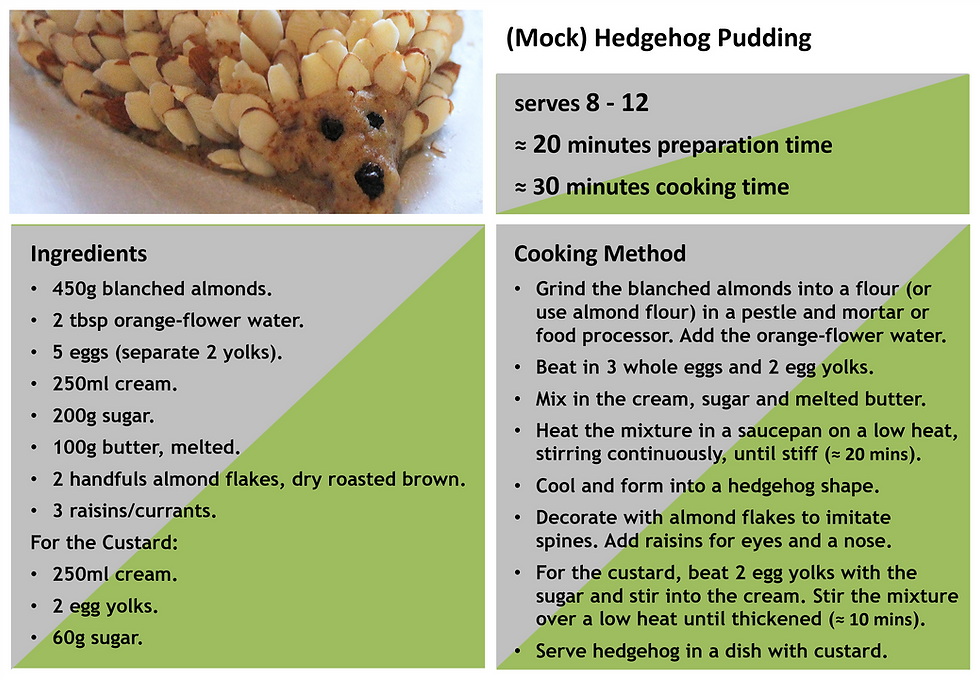
Mock Hedgehog Pudding is made from “marchpane”, an early form of marzipan. Mediæval chefs would create these fake hedgehogs to entertain guests at feasts. The body was fashioned from either from almond paste or by filling an animal stomach with meat and spices (think haggis). The pudding was adorned with almond flakes to mimic the hedgehog’s spines. The following recipe is taken from an 18th-century cookbook:
The Golden Age
From the end of the 15th-century English sailors started on a series of daring and dangerous expeditions. There are several reasons why these Tudor adventurers decided to explore the world, but the most obvious was to become rich by finding new places to trade and to bring back expensive goods like spices, silk and precious metals. Exploring the oceans led to better ship building, better navigation, more accurate maps, and a better knowledge of the world. New words were introduced to English from faraway lands and English as a language was exported to the new world when the Tudors began to colonise other countries. By the 18th-century Britain had become a major trading nation setting in motion the eventual establishment of an Empire covering a quarter of the world. New discoveries were made and traded. Tobacco, for example, potatoes and maize were all brought back from the Americas to Britain making rich men of those involved in the trade. On a darker note, the colonies in America soon needed a much larger workforce to supply the demand for, say, tobacco. The result was the African-American slave trade.

When sailors finally encountered Green Sea Turtles they saw an opportunity to catch them and keep them alive on board ship as a source of delicious, fresh meat. Initially, few turtles survived the sea voyage to England. Eventually, circa 1728, “sea-tortoise” became popular in England as:
“Its Flesh is between that of Veal, and that of a Lobster, and is extremely pleasant...They are frequently brought to England in Tubs of Sea Water, and will keep alive a long time.”
The earliest English recipes are for roast or boiled turtle, only later would they be used in a soup. After sailors arriving from the West Indies landed a couple of turtles on British soil, the demand for them between 1740 and 1750 was a catalyst for increased importation from Ascension Island or the West Indies. Samuel Birch is credited with being the first to serve turtle soup in London, spicing it with lemons and cayenne pepper. In the 1750s turtle soup became immensely popular and without it no dinner party was thought complete. Indeed, from 1761 to 1825, it was never absent from the London Lord Mayor's Day Banquet. At its peak the trade in live turtles saw 15,000 being shipped from the West Indies per year. They were expensive to transport, however, and because such numbers were being caught, the trade was not sustainable. Green turtles were almost hunted to extinction, which simply drove prices up even further. By about 1800, a good dinner portion was reputedly 2.5 kg (6 lb) of turtle (live weight) while, in August 1808, 1,100 kg (2,500 lb) of turtle was needed to make the dinner soup consumed by 400 diners in one London Tavern. Isabella Beeton noted in 1861 turtle soup was “…the most expensive soup brought to the table”.
“Take your tortoises and cut off their heads and feet and boyl them in fair water, and when they are almost boyl'd, put to them some white wine, some sweet herbs, and a piece of bacon, and give them a brown in the frying pan with good butter, then lay upon your bread a-steeping in good strong broth, and well-seasoned; garnish the dish with green sparrow-grass [asparagus] and lemon over it.”
Giles Rose, 1682 [1]
Mock Turtle Soup By the late 19th-century, overhunting had caused the green turtle population to plummet to near extinction levels. Consequently, the price of the soup rose dramatically driving the creation of a more economical substitute. Mock turtle soup became popular in its own right such that the two dishes were sometimes served at the same banquet.

Mock versions often use brains and offal to duplicate the texture and flavour of the original turtle meat. Indeed, a calf's head soup, which had been known in England before the importation of turtles began, was widely adopted as another economical and popular substitute (Ching, 2016, 79-89). In the United States, mock turtle soup eventually became more popular than the original dish and remains so in Cincinnati. The soup is also a traditional dish in the Lower Saxony areas of Germany where it is considered a specialty of “English cuisine”. By the late 19th-century commercial brands of canned mock turtle soup were available and advertising, ironically, warned consumers to "Beware of Imitations" (Ching, 2016, 79-89).
Tastes Of History’s version was adapted for history events themed around the Golden Age of Piracy:

Out of Necessity
Between the First and Second World Wars many households were struck by The Great Depression, a severe worldwide economic downturn that began in 1929 and lasted until about 1939. Triggered by a combination of interrelated economic factors, the period was marked by significant declines in output, severe unemployment, and profound changes in economic policy.
The most significant event that marked the beginning of the Great Depression was the stock market crash on 24th October 1929, known as Black Thursday. This crash led to a loss of confidence in the economy and a sharp decline in consumer spending. As the economy slowed, consumer demand fell, leading to decreased production and rising unemployment. Many businesses were forced to close or reduce their workforce. A series of bank failures in the early 1930s further exacerbated the economic crisis, as people lost their savings and credit became scarce. Globally, the gold standard linked many countries’ economies, transmitting the American downturn to other nations, thus leading to a worldwide economic crisis.

Mock Apple Pie is one of the most famous examples of Depression-era ingenuity when Americans turned to creative solutions to stretch their food supplies. While versions of this dish existed before the 1930s, it became more widely known after 1934 the year Ritz Crackers were introduced in the United States by Nabisco, an American manufacturer of cookies and snacks. Instead of apples, Mock Apple Pie relies on crushed Ritz Crackers which, when soaked in a syrup made from sugar, water, lemon juice, and spices, take on a texture resembling cooked apples. The illusion is further enhanced by the addition of cinnamon whose flavour tricks the taste buds into thinking apples are present. When baked in a traditional double-crust pastry, further reinforcing its resemblance to classic apple pie, the filling softens, thickens, and binds together just like real fruit. The result looks, smells, and tastes like a traditional apple pie albeit without a single apple present. Rather helpfully Nabisco printed the recipe on the back of its Ritz boxes thereby ensuring Mock Apple Pie gained national recognition. During tough economic times of The Depression, the recipe allowed families to enjoy a familiar taste without incurring the cost of fresh apples. It soon became a staple in any resourceful household forced to rely on affordable, shelf-stable ingredients.

Cooking on Wartime Rations
Before the outbreak of World War Two Britain imported 70% of the food needed to feed the nation equating to around 20 million tons per year. When hostilities commenced attacks on merchant shipping by the Nazi’s surface fleet, U-Boats and its air force saw imports reduced to about 1/3rd leaving many foods impossible to obtain. In 1940 the Minister for Food banned the importation of bananas, popular with many Britons, because they were transported in refrigerated ships needed for other wartime purposes. Ever resourceful British cooks thus devised recipes for “mock bananas” made from parsnips flavoured with sugar and banana essence as substitutes for the fruit. Other fake dishes soon followed.
To counteract the reduction of meat and other rationed goods such as milk, eggs, sugar, cheese, the British government sought to provide families with alternative food options and “mock” ingredients and recipes were created to fill the void. These “mock foods” were intended to simulate a dish or an ingredient where the latter was difficult or impossible to purchase in shops because of the rationing system. Mock recipes existed for foods such as mayonnaise, marzipan, cream, sausage, and duck. Many mock recipes were written in wartime by Britain’s Ministry of Food to promote the use of substitutes in place of the actual foods. Yet simply naming a recipe “mock duck” was not a guarantee it looked or tasted like the real thing. Indeed, often the recipes had no resemblance, and often little similarity in taste to the actual food or dish that it sought to imitate. But it was wartime, so “Keep Calm and Carry On”.
Mock Duck
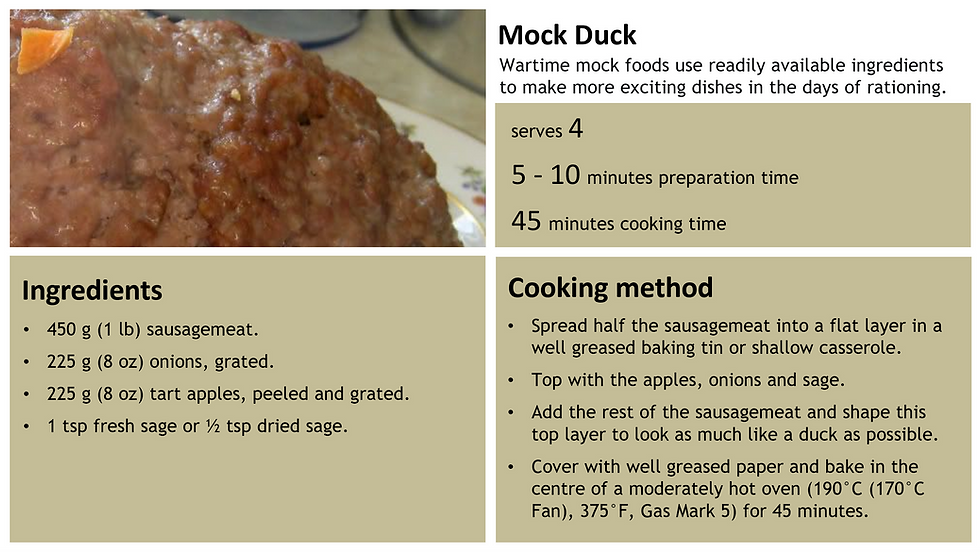
This recipe for Mock Duck was discovered on The 1940’s Experiment website, but it can also be found on page 74 of “We’ll Eat Again”, a collection of period recipes selected by cookery writer and wartime broadcaster Marguerite Patton in association with The Imperial War Museum. Aside from shaping the mixture to look somewhat like a duck, this is a relatively simple dish but one that would be enhanced with addition of perhaps new potatoes and seasonal vegetables.
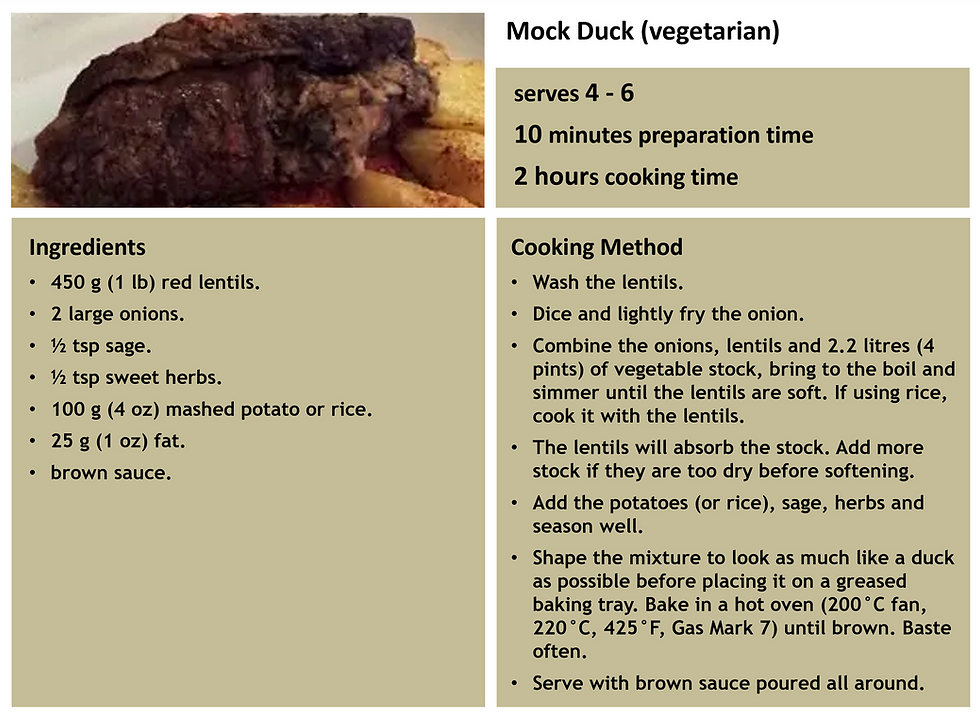
A vegetarian alternative replaces the sausage meat with red lentils:

Yet another version, Mock Goose, may be found on page 75 of “We’ll Eat Again”. This recipe is also suitable for vegetarians as potatoes are the main ingredient. The Ministry of Food promoted the humble potato as a valuable yet cheap source of energy, and one that would protect the nation from ill-health. The use of potatoes was championed in soups, salads, savoury supper dishes, potato pastry (the recipe for which may be found here), and even in biscuits. Indeed, the “Dig for Victory” campaign during World War II that encouraged Britons to grow their own food and make the most of rationed ingredients also introduced them to Potato Pete. He became well-known through the “Potato Pete Recipe Book”, published by the Ministry of Food, that included various recipes and advice on using potatoes effectively during rationing. This popular character helped promote the importance of potatoes as a staple food during the war, contributing to the national effort to combat food shortages.

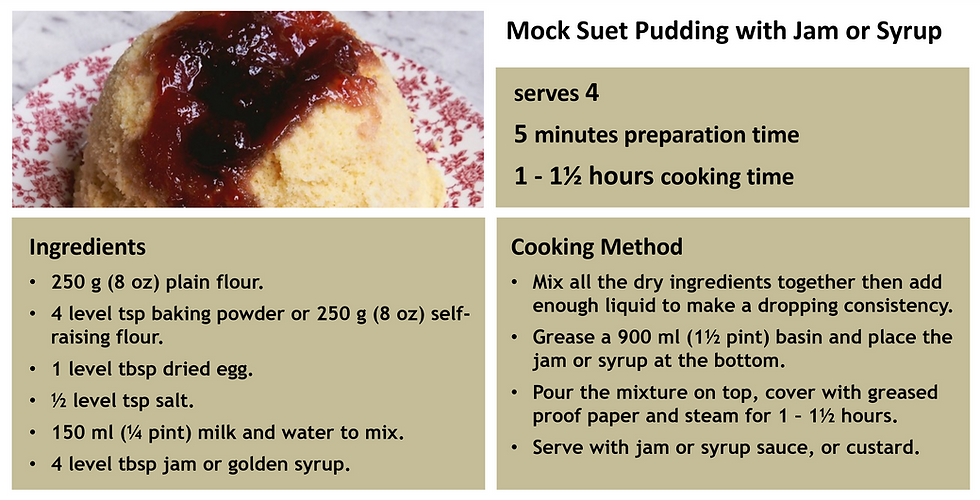
Despite Britain being at war, desserts, puddings and cakes remained an important staple in everyday life. The rationing of key ingredients such as fats and sugar did not stop resourceful cooks from producing treats for the family. One such wartime dessert recipe for Mock Suet Pudding with either jam or syrup may be found in the Ministry of Food leaflet “Making the Most of the Fat Ration” (O’Mara, 2007, 150). A second version from the same leaflet omits the jam or syrup but adds 50 g (2 oz) each of sugar and dried fruits with the flour. Of note, both of these recipes made use of dried egg powder available on rations books. The powder was pure egg with all the moisture removed. This allowed one tin of egg powder to substitute for a dozen fresh eggs. Some recipes used the powder dry from the tin, but to reconstitute dried egg one had to blend a level tablespoon of powder with two tablespoons of water. This produced the equivalent of one fresh egg. Unfortunately, if people were too generous with the amount of egg powder, then the result was prone to a rather unpleasant taste giving dried egg powder its enduring, unfortunate reputation.
And finally Even when the actual ingredients have changed there is a certain level of comfort and continuity to be derived from retaining the names of popular dishes, albeit with the term “mock” added. It is similar to modern-day practices of creating vegan bacon, which is supposed to simulate the look and taste of real bacon although one might argue it rarely does. That said, as plant-based “mock meat” recipes have evolved, many newer products now have the look, and in most cases, a similar taste to the meat they replace. People consume these fake foods for myriad reasons, including health or for vegan/vegetarian lifestyle choices. Yet, this means a vegan or vegetarian “sausage” is a misnomer and dishonest. A sausage by its very definition is an “article of food consisting of chopped or minced meat, seasoned and stuffed into the cleaned gut of an ox, sheep, or pig, and tied at regular intervals” (Etymonline, sausage). Sausages, therefore, are very definitively not for vegans or vegetarians. But people desire familiarity, so consuming foods with the same name, albeit with different ingredients and different tastes, allows us to not alter our eating habits and to continue enjoying the things we have always eaten. Bon appétit!
References:
Barnett, E. (2024), “Hedgehog Pudding”, BBC History Magazine November 2024, p.86.
British Food History (2016), “Mock Turtle Soup”, available online (accessed 13th July 2023).
Ching, M. (2016), “The Flow of Turtle Soup from the Caribbean via Europe to Canton, and Its Modern American Fate”, Gastronomica 16 (1), pp. 79–89.
Eberhardt, D. (2025), “1930’s Mock Apple Pie: A No-Apple Recipe That Tastes Real”, Nature of Home, available online (accessed 28th November 2025).
Michael O’Mara Books, (2007), “Eating for Victory: healthy home front cooking on war rations”, London: Michael O’Mara Books Ltd.
Rennison, N. (2023), “Q&A: Fake fruit”, BBC History Magazine February 2023, p.43.
Widger, D. (ed), (2004), “The Satyricon, Vol. 2 (The Dinner of Trimalchio)” by Petronius Arbiter, Project Gutenberg, available online (accessed 1st December 2025).
Endnotes:
1. An elusive character in history, Giles Rose is thought to have been one of the master cooks to King Charles II. In 1682 he published a translation from French of a work written some twenty years earlier examining the roles of the senior staff responsible for feeding a large household.


Comments