
On This Day: Duke William conquers

October 14th, 1066: A pivotal day in Britain’s history as Anglo-Saxon England abruptly ended.

What followed we might today call “regime change” as William the Conqueror’s accession went far beyond founding a new royal dynasty. As Domesday Book shows, by 1086, just twenty years later the old ruling class of Anglo-Saxon England had been entirely replaced by Norman overlords. With more than 90% of the land now held by continental newcomers, the country’s physical appearance was almost immediately affected. Castles, which had hardly existed in England before 1066, were built in their hundreds. Anglo-Saxon churches and religious institutions were torn down and rebuilt in the Romanesque style. The “Harrying of the North” left vast swathes of land devastated while notoriously forcing northern England to submit to William’s rule.
Less obvious were the subtle changes made to English life. After the Conquest, new ideas were introduced on how society should be regulated. Slavery, commonplace amongst Anglo-Saxons, disappeared over the next fifty years, and the notion of sparing a defeated opponent became the new norm for the ruling elite. The rapid adoption of these concepts set the English apart from their Welsh and Scottish neighbours. The latter continued the wholesale slaughter of their enemies waging war as a form of slave-hunt. The perception of the Irish, Scots and Welsh as uncivilised barbarians was almost certainly a result of the Norman conquest and, as mediæval historian, author and broadcaster Marc Morris argues, “fuelled the aggressive English colonisation of those countries in the centuries that followed.”
Prelude
The dramatic events of 1066, with three kings sitting on the throne of England, had a complex inter-connected Anglo-European ancestry. In summary, in AD 911, the Carolingian ruler Charles the Simple allowed a group of Vikings to settle in Normandy under their leader Rollo. Their settlement proved successful, and they quickly adapted to the indigenous culture, renouncing paganism, converting to Christianity, and intermarrying with the local population. Over time, the frontiers of the duchy expanded to the west. In 1002, King Æthelred II married Emma, the sister of Richard II, Duke of Normandy. Their son Edward the Confessor spent many years in exile in Normandy before succeeding to the English throne in 1042. This led to the establishment of a powerful Norman interest in English politics, as Edward drew heavily on his former hosts for support, bringing in Norman courtiers, soldiers, and clerics and appointing them to positions of power, particularly in the Church. Edward was childless and embroiled in conflict with the formidable Godwin, Earl of Wessex, and his sons, and he may also have encouraged Duke William of Normandy’s ambitions for the English throne.
Succession crisis

After 24 years as king, Edward “the Confessor” dies childless on January 5th, 1066 without an heir creating a succession struggle between several claimants to his throne. Shortly before his death, however, it is believed Edward entrusted the kingdom to his wife, Edith of Wessex, and to Edith’s brother, none other than Harold Godwinson. He was the richest, most powerful Anglo-Saxon Earl and member of the prominent Godwin family, with its ancestral ties to Cnut the Great, King of Denmark, England and Norway. Upon the death of his brother-in-law King Edward, the Anglo-Saxon nobles of the Witenagemot (or Witan) convened and confirmed Harold’s succession.
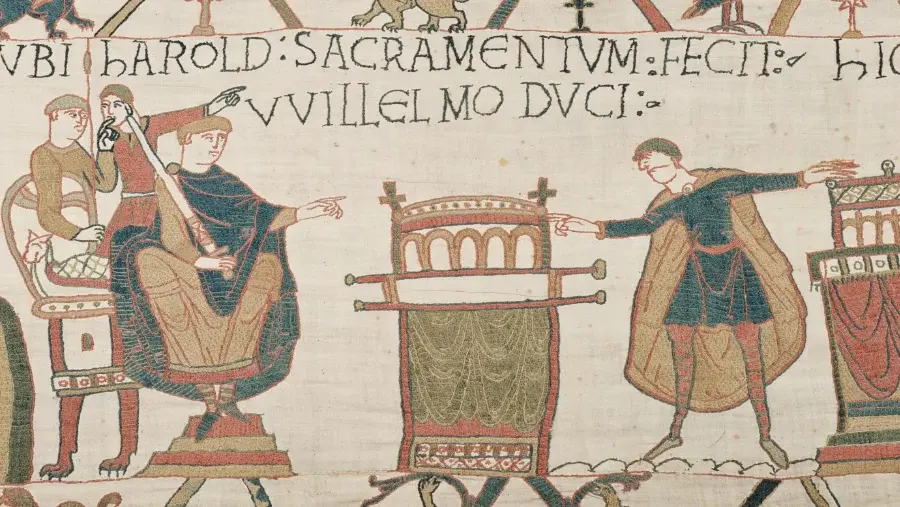
Harold was crowned by Ealdred, the Archbishop of York, although Norman propaganda claimed the ceremony was performed by Stigand, the uncanonically elected Archbishop of Canterbury. The new king was at once challenged by two powerful neighbouring rulers. Duke William claimed he had been promised the throne by King Edward and that Harold had sworn an oath on sacred relics in agreement. Harald Hardrada of Norway also contested the succession. His claim to the throne was based on an agreement between his predecessor Magnus the Good and the earlier King of England Harthacnut, whereby, if either died without heir, the other would inherit both England and Norway. William and Harald Hardrada immediately set about assembling troops and ships for separate invasions.

January 6th, a day after Edward’s death, witnessed both the old king’s burial in Westminster Abbey and the coronation of Harold who, it is widely held, became the first English monarch to be crowned in the Abbey. That day in January 1066 should have been a joyous one had it not been that in 1051 King Edward appears to have chosen Duke William of Normandy as his successor to the English throne. Confirmation of this inconvenient truth is seemingly borne out by the account of William of Poitiers. He records that King Harold II sent an envoy to Duke William who, on behalf of Harold, admitted that Edward had promised the throne to William but argued that this was over-ridden by his deathbed promise to Harold. In reply, William did not dispute the deathbed promise but argued that Edward’s prior promise to him took precedence. Thus, on hearing of Harold’s coronation, William began plans to invade England and commenced the building of 700 warships and transport ships at Dives-sur-Mer on the Normandy coast. Initially, however, William could not garner support for the invasion until his argument that Harold had sworn on sacred relics to support William’s claim to the English throne was accepted by the Church. With the latter’s blessing, Norman nobles flocked to Duke’s cause. William spent almost nine months on his preparations, assembling a large invasion fleet and gathering an army from Normandy and the rest of France, including large contingents from Brittany and Flanders.
English army and Harold’s preparations

Anticipating an invasion, Harold assembled an army largely composed of land owning men who were equipped by their community to meet their king’s requirement for military service. The English army consisted entirely of infantry. It is possible that some of the wealthier men and nobility rode to battle but then dismounted to fight on foot. The core of Harold’s army was built round Housecarls (Old Norse: húskarl; Old English: huscarl), an institution originated amongst the Norsemen of Scandinavia and brought to Anglo-Saxon England during the Danish conquest in the 11th-century. Originally referring to non-servile manservants or household bodyguards, Harold’s housecarls were well-trained and paid as full-time professional soldiers. Each man was armoured with a conical helmet, a mail hauberk, and a shield which might be either kite-shaped or round. While armed with swords, the Bayeaux Tapestry reveals that many housecarls fought with the two-handed Dane axe or long axe. These were formidable weapons with a long wooden shaft varying in length between 0.9 to 1.2 m (2 ft 11 in - 3 ft 11 in) and 1.5 to 1.7 m (4 ft 11 in - 5 ft 7 in). Sometimes referred to as a broadaxe from the Old Norse breiðøx, their broad, thin blades were intended to deliver powerful cuts effective against cavalry, shields and unarmoured opponents. The rest of the English army was made up of levies from the fyrd, who also fought as infantry but were more lightly armoured and were not professional soldiers. Most of this infantry would have formed part of the shield wall, in which the front ranks locked their shields together. Behind them would have been axemen and javelin throwers as well as archers.
The fyrd was a type of early Anglo-Saxon army mobilised from freemen or paid men to defend their Shire lord’s estate, or from selected representatives to join a royal expedition. One man, providing his own arms and provisions, was supposed to serve for every five hides, a unit of land nominally capable of supporting one household. Service in the fyrd was organised round the “hundred”, an Anglo-Saxon administrative division that was geographically part of a larger region such as a Shire. Men of the fyrd served under the command of their respective Eorl (Earl), Bishop or Shire Reeve (sheriff). As a whole, England could furnish about 14,000 men for the fyrd, when it was called out. The fyrd usually served for two months, except in emergencies. It was rare for the whole fyrd to be called out. A national mobilisation only occurred three times, in 1051, 1052, and 1065.
Tostig and Hardrada’s invasions

To complicate matters further, in early 1066 Harold’s exiled brother Tostig Godwinson raided south-eastern England with a fleet he had recruited in Flanders, later joined by other ships from Orkney. Threatened by Harold’s fleet, Tostig moved north and raided in East Anglia and Lincolnshire. He was driven back to his ships by the brothers Edwin, Earl of Mercia and Morcar, Earl of Northumbria. Deserted by most of his followers, Tostig withdrew to Scotland, where he spent the middle of the year recruiting fresh forces.
William had mustered his forces at Saint-Valery-sur-Somme and was ready to cross the English Channel by about August 12th. But the crossing was delayed, either because of unfavourable weather or to avoid being intercepted by Harold’s powerful English fleet. Consequently, after waiting all summer on the South coast for William’s expected invasion, and with provisions running out, Harold was forced to disband the fyrd on September 8th. While his army returned to their villages to bring in the harvest, Harold headed to London. On the very same day King Harald III of Norway, known as Hardrada or “hard ruler”, invaded northern England to pursue his claim to the English crown. According to most contemporary sources, the Norwegian king and Tostig met at Tynemouth - a town literally at the mouth of the River Tyne. Harald Hardrada had a force of, at the most, around 10,000 to 15,000 men, transported on 240 to 300 longships, while Tostig had a mere 12 ships with soldiers.

Four days after the Norwegian landing, on September 12th Duke William’s fleet finally sailed from Normandy. Several ships sank in storms, however, forcing the fleet to shelter once more at Saint-Valery-sur-Somme and wait for conditions and the wind to change. Meanwhile in the north of England, on September 20th, the invading forces of Hardrada and Tostig defeated a hastily gathered English army led by earls Edwin of Mercia and Morcar of Northumbria at the Battle of Fulford, two miles south of York. The battle was a decisive victory for Harald and Tostig and forced the people of York to surrender to the Norwegian king four days later. This would be the last time a Scandinavian army defeated English forces, however.
Learning of the “Viking” invasion, King Harold led his army North on a forced march from London, reaching Yorkshire in just four days. Thus, on the same day as York surrendered to Hardrada and Tostig, King Harold arrived with his army in Tadcaster, just seven miles from Riccall where the Norwegian fleet was anchored. The Anglo-Saxons probably scouted the Norwegian fleet in preparation for a surprise attack but, as Hardrada had left no forces in York, King Harold marched right through the town to Stamford Bridge.
Earlier that day, September 25th, Hardrada and Tostig had departed their landing place at Riccall with two-thirds of their forces, leaving the remainder behind to protect the ships. The Norwegians wore light armour since, as agreed the day before, they were only expecting to meet the citizens of York to decide who should manage the town under Hardrada’s rule. As they arrived at the agreed meeting place at Stamford Bridge, Hardrada saw King Harold’s forces approaching, heavily armed and armoured, and greatly outnumbering the Norwegians. The Anglo-Saxon’s forced march had caught Hardrada and Tostig by surprise.

According to the 12th-century Icelandic historian Snorri Sturluson, a single man rode up to Hardrada and Tostig before the battle. He gave no name, but spoke to Tostig, offering the return of his earldom if he would turn against Hardrada. Tostig asked what his brother Harold would be willing to give Hardrada for his trouble. The rider replied: “Seven feet of English ground, as he is taller than other men” before riding back to the Anglo-Saxon host. Hardrada was impressed by the rider’s boldness, and asked Tostig who he was. Tostig replied that the rider was Harold Godwinson himself.
The Norwegian army was, in the end, severely beaten. Hardrada and Tostig were both killed. Hardrada had been struck in the throat by an arrow and killed early in the battle while reputedly in a state of berserkergang (berserker fury). Wearing no body armour, his sword gripped in his two hands, the king of Norway fought aggressively before being slain.
Although sources state that Hardrada’s remaining army only filled between 20 and 25 ships on the return to Norway, it is likely that this number only accounts for the Norwegian forces. Most of the forces from Scotland and Orkney probably remained at Riccall throughout the battle and were not counted in the traditional figure. Even so, this was the last, so-called, Viking invasion of England.
William lands
The deaths of Tostig and Hardrada at Stamford Bridge left William as Harold's only serious opponent. On September 27th, having been delayed by wind and tides, the Norman fleet finally set sail for England. Arriving the following day William established a castle within the ruins of the Roman fort at Pevensey on the coast of East Sussex. The landing of perhaps 7,000 Normans in the south meant that celebrating the Anglo-Saxon success at Stamford Bridge was short-lived.
The exact numbers and composition of William’s force are unknown. One contemporary document claims that William had 776 ships, but this number cannot be relied upon. Figures given by contemporary writers for the size of the army are highly exaggerated, varying from 14,000 to 150,000. Modern historians have offered a range of estimates for the size of William’s forces, the average being somewhere between 7,000 and 8,000 men including 1,000 to 2,000 cavalrymen. Whatever the number, the Norman army consisted of about one half infantry, one quarter cavalry, and one quarter archers or crossbowmen.

Dressed almost identically to the English, the Normans also wore mail hauberks, usually knee-length, with slits to allow riding, some with sleeves to the elbows. Some hauberks may have been made of scales attached to a tunic, with the scales made of metal, horn or hardened leather. Headgear was the popular conical helmet with a vertical nasal guarding the bridge of the nose. Both horsemen and infantry carried shields. The latter’s shields were usually round and made of wood with metal reinforcement, while the cavalry had adopted a kite-shaped shield offering better protection for horse and rider. The cavalry was armed with a long spear or lance. Couching the lance, that is carrying it tucked under the right arm against the body, was relatively new innovation but probably not used at Hastings, as the terrain was unfavourable for long cavalry charges. Both infantry and cavalry usually fought with a straight sword, long and double-edged. The infantry could also use javelins and long spears. Some of the cavalry may have used a mace instead of a sword. Norman archers, as depicted on the Bayeaux Tapestry, appear to have used a self-bow or a crossbow, and most appear not to have worn armour.
Harold moves south
After defeating his brother Tostig and Harald Hardrada in the north, King Harold left much of his forces in the north, including Earls Morcar and Edwin, and marched the rest of his army south to deal with the threatened Norman invasion. It is unclear when Harold learned of William’s landing, but it was probably during the march. It seems Harold stopped in London for about a week before the battle, so it is likely that the move south took about a week, with the army averaging about 27 miles (43 km) per day, for the approximately 200 mi (320 km). Having gathered fresh troops as he went, on the night of October 13th Harold eventually made camp at Caldbec Hill, near a “hoar-apple tree” [1]. In hastily built earthworks, the English army was positioned only about 8 miles (13 km) from William’s recently constructed, prefabricated castle at Hastings.
The armies assemble
The following day, October 14th, Harold’s army moved to a defensive position on Senlac Hill (near the present day town of Battle) only 6 miles (9.7 km) from William’s base. Although Harold had attempted to surprise the Normans, William’s scouts had reported the English arrival to the duke. Even so the exact events preceding the battle remain obscure, with contradictory accounts in the sources. Yet all agree that William’s army advanced from his castle to confront Harold.
Sunrise on October 14th, 1066 was at 6:48 am, with the day unusually bright. The precise route of the English army southward to the battlefield is not known. Several routes are plausible, but whichever was taken Harold’s forces deployed in a small, dense formation at the top of steep slope, with their flanks protected by woods and marshy ground in front of them. The line may have extended far enough to be anchored on a nearby stream. The English front ranks held their shields close together, or even overlapping, to form a protective shield wall. Sources differ on the exact site of the English position, but the generally accepted version is along a ridge where the Battle Abbey later would be built.

The exact numbers present at this pivotal battle are unknown. Even modern estimates vary considerably with most historians arguing for a figure of 7,000–8,000 English troops. That said, the composition of the forces present is somewhat clearer. As previously mentioned, the English army was composed almost entirely of infantry, a mix of housecarls and the fyrd, and had few archers, whereas only about half of the invading Norman force was infantry, the rest being split equally between cavalry and archers.
More is known about the Norman deployment. Duke William appears to have arranged his forces in three groups, known as “battles”. On the left were positioned the Bretons, together with those men from Anjou, Poitou and Maine, led by Alan the Red, a relative of the Breton count. The Normans formed the centre battle under the direct command of Duke William and with many of his relatives and kinsmen grouped around the ducal party. The final division, on the right wing, consisted of the Frenchmen, together with some men from Picardy, Boulogne, and Flanders and was commanded jointly by William fitzOsbern and Count Eustace II of Boulogne. Archers, probably interspersed with a few crossbowmen and slingers, formed the front lines with spear-armed infantry behind them. With the Norman cavalry held in reserve, this disposition strongly suggests William planned to open the battle with archers weakening the enemy with arrows before advancing his infantry to engage in close combat. The infantry presumably would create openings in the English shield wall to be exploited by a cavalry charge aimed at breaking the English forces and pursuing any fleeing soldiers.
Battle is joined
Unfortunately, many of the primary accounts contradict each other at times so it is difficult to be certain what exactly happened during the battle. The only undisputed facts are that fighting began at 9 am Saturday October 14th, 1066 and that the fighting lasted until dusk. Indeed, the sun set at 4:54 pm leaving the battlefield mostly dark by 5:54 pm and in full darkness about 30 minutes later (6:24 pm). It was not until 11:12 pm that night that the moon rose to shed some light on the aftermath of battle.
The battlefield lies 7 miles (11 km) north of Hastings at the site of the present-day town of Battle, between Caldbec Hill to the north and Telham Hill to the south. The area was heavily wooded, with a marsh nearby. The name traditionally given to the battle is unusual as there were several settlements much closer to the battlefield than Hastings. The Anglo-Saxon Chronicle called it the battle “at the hoary apple tree”, which does suggest Caldbec Hill (refer above) may have been the centre of the fighting. Within 40 years, however, the battle was described by the Anglo-Norman chronicler Orderic Vitalis as “Senlac”, a Norman-French adaptation of the Old English word “Sandlacu” meaning “sandy water”. This may have been the name of the stream that crosses the battlefield. Either way, by 1086 the Domesday Book referred to the battle as “bellum Haestingas”, that is, the “Battle of Hastings”.

The fighting began with the Norman archers shooting, to little effect, uphill at the English shield wall. The uphill angle meant that the arrows either bounced off English shields or overshot their targets and flew over the top of the hill. Any prolonged archery duel was hampered by the lack of English archers. The practice at the time was to recover your enemy’s arrows to continue shooting but the Norman archers found that, as there were so few English archers, there were few arrows to be gathered up and reused. With the archery attack effectively negated, William ordered the spearmen forward only to be met with a barrage of missiles; not arrows but spears, axes and stones. The Norman infantry was unable to force openings in the shield wall, so the cavalry advanced in support. The cavalry also failed to make headway, and a general retreat began, blamed on the Breton division on William’s left. At this point a rumour started that the Duke had been killed adding to the confusion of battle. The English forces began to pursue the fleeing invaders, but William rode through his forces, showing his face and yelling that he was still alive. The Duke then led a counterattack against the pursuing English forces; some of the English rallied on a hillock before being overwhelmed.

It is unknown whether the English pursuit was ordered by King Harold or whether it was a spontaneous act. It is during this action that the Bayeux Tapestry depicts the death of Harold’s brothers Gyrth and Leofwine occurring just before the fight around the hillock. This may mean that the two brothers led the pursuit. The Norman account of the battle, Carmen de Hastingae Proelio (“Song of the Battle of Hastings”), relates a different story for the death of Gyrth, stating that Duke William slew Harold’s brother in combat, perhaps thinking that Gyrth was Harold. To confuse matters, William of Poitiers states that the bodies of Gyrth and Leofwine were found near Harold’s, implying that they died late in the battle. Had they died earlier in the fighting, then it is entirely possible that the bodies of the two brothers were recovered to Harold’s position, thus accounting for their being found near his body after the battle.
Feigned flights
If a lull occurred early in the afternoon then it was probably a much needed break for rest and food. Perhaps William took this time to implement a new strategy, one inspired by the English pursuit and subsequent rout by the Normans. If the Normans could send their cavalry against the shield wall and draw the English into more pursuits, breaks in the English line might form. William of Poitiers [2] says the tactic, employed by other Norman armies during the period, was used twice during the battle. It has been argued that the story of the use of feigned flight [3] as a deliberate tactic was invented after the battle, but most historians agree that it was used by the Normans at Hastings.

Although the feigned flights did not break the lines, it is possible that they thinned the number of housecarls in the shield wall. Replaced with members of the fyrd, the English shield wall held. Archers appear to have been used again before and during an assault by the cavalry and infantry led by the Duke. Although 12th-century sources state that the archers were ordered to shoot at a high angle to shoot over the front of the shield wall, there is no trace of such an action in the more contemporary accounts. It is not known how many assaults were launched against the English lines, but some sources record various actions by both Normans and Englishmen that took place during the afternoon’s fighting. The Carmen claims Duke William had two horses killed under him during the fighting, but William of Poitiers’ account states it was three.
An arrow in the eye
King Harold appears to have died late in the battle, although accounts in the various sources are contradictory. William of Poitiers, for example, only mentions his death without giving any details on how it occurred. The notion that Harold died by an arrow to the eye is a popular belief today, but this historical legend is subject to much scholarly debate. The Norman account of the battle, Carmen de Hastingae Proelio, said to have been written shortly after the battle by Bishop Guy of Amiens, recounts that Harold was killed by four Norman knights, probably including Duke William. Much later in the 12th-century, Anglo-Norman histories (such as William of Malmesbury’s Gesta Regum Anglorum and Henry of Huntingdon’s Historia Anglorum) recount that Harold died by an arrow wound to his head. Subsequent accounts reflect either one or both these two versions.

It is true that in one panel of the Bayeux Tapestry a figure beneath the inscription “hic Harold Rex Interfectus Est” (“here Harold the King has been killed”) is shown gripping an arrow that has struck his right eye. For many people this is proof that the figure with an arrow in his eye directly beneath his name is indeed King Harold [4]. Yet some historians have questioned whether this man was intended to be the king or whether the embroiders intended Harold to be the figure lying to the right, almost supine, being mutilated beneath a horse’s hooves. Scholars examining other panels from the Tapestry dispute the “arrow in the eye” version arguing that the visual centre of a scene, not the location of the inscription, identifies named figures. To confuse things further, an arrow volley probably would have been loosed at the Anglo-Saxon defending the ridge before a Norman cavalry charge. Thus, is it possible that both accounts are correct, and that Harold suffered first the mortal eye wound, then the mutilation of his body with the Tapestry attempting to depict both events in one scene.
The mutilation of the king’s body is certainly supported by at least one account which states: “the two brothers of the King were found near him and Harold himself, stripped of all badges of honour, could not be identified by his face but only by certain marks on his body.” Another source notes that Harold’s common-law widow, Edith Swanneck [5], was called to identify the body by some private mark known only to her.
The truth of the “arrow in the eye” may never be proven, but King Harold’s death left the English force leaderless. The army began to collapse, with many men fleeing the battlefield. The soldiers of the royal household, however, gathered around Harold’s body and fought to the bitter end. The Normans began to pursue the fleeing troops, and except for a rear-guard action at a site known as the “Malfosse” or “Evil Ditch”, the battle was over. What happened at the Malfosse, and where it took place, is unclear. The rear-guard action is said to have occurred at a small fortification or set of trenches where some Englishmen rallied and seriously wounded Eustace of Boulogne before finally succumbing to the Normans.
The third king that year
The day after the battle, Harold’s body was identified, and his personal standard presented to William. Later he gifted it to the Pope presumably in gratitude for papal support. Exact casualty figures are unknown. The bodies of the English dead, including some of Harold’s brothers and housecarls, were left on the battlefield only to be removed by relatives later. The Norman dead were said to be buried in a large communal grave, which to this day has not been found. Likewise, Harold’s body has disappeared from the archaeological record. One story relates that Gytha, Harold’s mother, offered the victorious Duke the weight of her son’s body in gold for its custody, but was refused. It is said William ordered Harold’s body be thrown into the sea, but whether that took place is unclear. Waltham Abbey, which had been founded by Harold, later claimed that his body had been secretly buried there. If so, then to date his grave has not been identified.

William expected to receive the submission of the surviving English leaders after his victory but instead, with the support of Earls Edwin and Morcar, Stigand, the Archbishop of Canterbury, and Ealdred, the Archbishop of York, the Witenagemot proclaimed Edgar the Ætheling [6] as king. William therefore advanced on London, marching around the coast of Kent to meet up with reinforcements that had landed by Portsmouth and met him between London and Winchester. He defeated an English force that attacked him at Southwark but was unable to storm London Bridge, forcing him to reach the capital by a more circuitous route. William moved up the Thames valley to cross the river at Wallingford, where he received the submission of Stigand, Archbishop of Canterbury. He then travelled north-east along the Chilterns, before advancing towards London from the north-west, fighting further engagements against forces from the city. By swinging around to the north, William had cut off London from reinforcements leading eventually to the English leaders surrendering to the Duke at Berkhamsted in Hertfordshire.
Anglo-Saxon England’s demise

The victorious William was acclaimed King of England and crowned by Ealdred, the Archbishop of York, in Westminster Abbey on December 25th, 1066. Even so, there continued to be resistance to William’s rule for several years. There were rebellions in Exeter in late 1067, an invasion by Harold’s sons in mid-1068, and an uprising in Northumbria in 1068. A year later William faced further troubles from Northumbrian rebels, an invading Danish fleet, and rebellions in the south and west of England. He ruthlessly put down the various risings, culminating in the “Harrying of the North” in late 1069 and early 1070 that devastated parts of northern England. At Ely in Cambridgeshire William defeated a further rebellion by Hereward the Wake in 1070. Twenty years later the Normans had achieved control of the England, Wales and even Ireland. So, the Battle of Hastings, in 1066, marked the end of Anglo-Saxon England and the beginning of Norman rule.
Legacy

Despite the foundation of Norman, and later Plantagenet, rule in England, Wales and Ireland, three key legacies emerged from the events of October 14th, 1066. Firstly, Battle Abbey was founded by William at the site of the battle. According to 12th-century sources, William had vowed to build a monastery if he won the battle. In 1070, Pope Alexander II ordered the Normans to do penance for killing so many people during their conquest of England. William vowed to build an abbey where the Battle of Hastings had taken place, with the high altar of the church on the supposed spot where King Harold fell in battle.
Secondly, keen to know what he was king of, mostly so he could tax the people, William ordered the compiling and writing of Domesday Book in AD 1086. The Anglo-Saxon Chronicle states that a year earlier, in 1085, the king sent his agents to survey every shire in England, to list his holdings and dues owed to him. Domesday Book remains an amazing record of early Norman England giving us the annual value of every piece of landed property to its lord, the resources in land, labour force, and livestock from which that value derived.

Thirdly is the Bayeux Tapestry, which is of major significance at the time of writing as it has returned to England for the first time in over 900 years. Although called a Tapestry it is in fact an embroidered narrative of the events leading up to Hastings. It was probably commissioned by Odo of Bayeux soon after the battle, perhaps to hang at the bishop's palace at Bayeux. The first recorded mention of the tapestry is from 1476, but it is similar in style to late Anglo-Saxon manuscript illustrations and was probably composed and executed in England. Normally, the Tapestry is displayed at the former Bishop’s Palace at Bayeux in France. Bon appétit!
Reference:
Morris, M., (2026), “What was the most important year in history - and why?”, Ask the Experts, History Extra Magazine, London: Immediate Media, p. 38.
Endnotes:
1. “Hoar” means grey and probably refers to a crab-apple tree covered with lichen that was likely a local landmark. ▲
2. William of Poitiers was a Norman priest serving as the chaplain to Duke William II of Normandy, for whom he chronicled the Norman conquest of England in his Gesta Willelmi ducis Normannorum et regis Anglorum. ▲
3. Examples of the use of feigned flight include the Battle of Arques around 1052, the Battle of Messina in 1060, and the Battle of Cassel in 1071. ▲
4. The issue is further confused by the fact that there is evidence that the 19th-century restoration of the Tapestry changed the scene by inserting or changing the placement of the arrow through the eye. ▲
5. “Swanneck” seemingly comes from the folk etymology which made her in Old English as swann hnecca or “swan neck”. This was most likely a corrupted form of the epithet swann hnesce meaning “Gentle Swan”. ▲
6. Ætheling is the Anglo-Saxon term for a royal prince with some claim to the throne. ▲

Comments